
How to Build a Backyard Pickleball Court
Table of Contents
- DIY Guide: How to Build a Backyard Pickleball Court for Homeowners
- Understanding Pickleball Court Dimensions
- Choosing the Right Location for Your Court
- Designing Your DIY Pickleball Court
- Materials Needed for Pickleball Court Construction
- Step-by-Step Guide to Pickleball Court Installation
- Maintenance Tips for Your Backyard Pickleball Court
Prefer to listen? Tap play below!
DIY Guide: How to Build a Backyard Pickleball Court for Homeowners
Pickleball is sweeping the nation as a recreational activity for families and friends of all generations. This fun sport melds tennis, badminton, and good-old ping-pong into a game appropriate for everyone. You are bonding with those closest to you while getting some exercise too! A great way to engage in the above activity at a reasonable cost is to DIY a pickleball court right at home.
This article aims to bring you piece-by-piece steps of building it. We will start with the dimensions. Soon, we will begin to cover the equipment you will need to put all this together. There will certainly be many design elements to a court. I want you to get crafty and enjoy the court with the kids on this wonderful game.
Understanding Pickleball Court Dimensions
A pickleball court is 20 feet wide and 44 feet long. This needs to be adhered to these dimensions for the best games and ability to keep players safe. Yes, an unnecessarily large pickleball court could lead to the issue of collision where a pickleball court too small may cause the same issue. Make sure to have more court space outside the lines for players to run for balls that are hit at a wide angle.
Choosing the Right Location for Your Court
When choosing a location, consider several things. You want plenty of sunlight. That will not only keep the surface of the court dry, but will also make for a more pleasurable place to play. On the other hand, the area still has to drain properly. The last thing you want is a big puddle on your court. Also, think about access. The court should be located somewhere you can get to it from your house and where there’s plenty of room for players and spectators on all sides.
Also, be aware that local zoning ordinances and homeowners association rules may apply. There are rules on the books in some jurisdictions that can affect the size, location, and other aspects of a pickleball court. If you live within the jurisdiction of an HOA, there may be rules that govern colors, height, the materials that may be used, and more. Find out what they are before you start making installations.
Designing Your DIY Pickleball Court
The first major design decision you will need to make is whether to go for a permanent or temporary court. Companies reinforce permanent courts with resilient materials such as asphalt or concrete. What you get is a playing surface that can fight off the external weather, in addition to internal wear and tear from everyday play. But you’re still looking at a singular, permanent area of the backyard. If you have space issues, and aren’t sure how to balance pickleball and, say, the trampoline, find a temporary court that is easy to put up and take down.
Make sure you like the play of the court. Certain surface materials can affect the ball movement of play. Asphalt or concrete offers a hard surface type, but that doesn’t mean it is solid, just fast. You will get a fast game out of asphalt with accelerated speed and bounce. Asphalt or concrete are the most commonly used materials for backyard courts. This is an available option for every backyard, and is not exclusive for weather/diverse climates. If you want a softer game and a longer play, go for clay or synthetic, but try not to play aggressively as it can be slippery. The soft material includes more infields and exclusive courts, probably private and public for that upscale look where you’d want to show it off, only because it raises that property value for a home or business. It does have its downside and drawbacks other than weather and potential water damage, it isn’t the highest cost out of the three, but it’s still high. Wood/carpet is indoor and the least expensive, but is also the least popular.
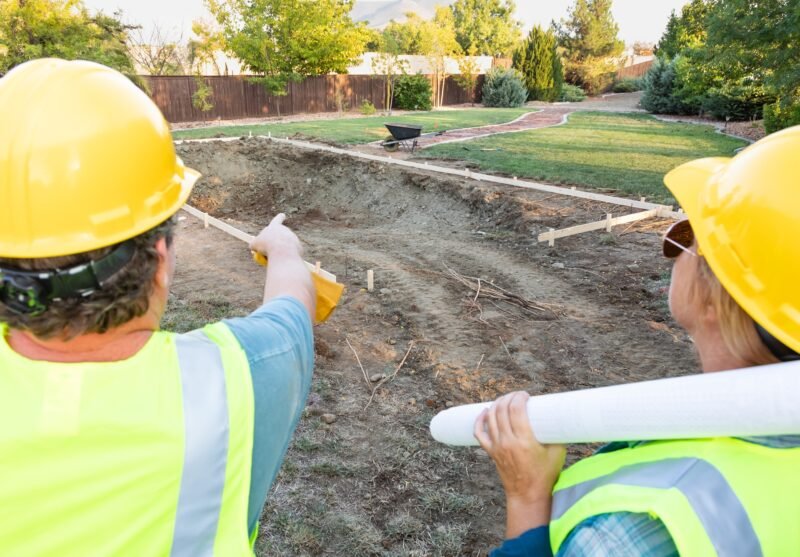
Male and Female Workers Overlooking Pool Construction Site
Materials Needed for Pickleball Court Construction
What do you need to build a pickleball court? The kind of materials that would give you the best performance and long life would include, of course, a good net, some good paddles, and some good balls. The playing surface is just as necessary for a good game as knowing the rules. Can you play on grass? Sure, why not, however, I would recommend either asphalt or concrete, or even some of the sport tiles that some companies sell.
To get the pricing you would have to shop around and get pricing from different sources; like over the internet, or from a big chain store that sells sporting goods, or from a sporting company that actually sells products from a catalog. The pricing would vary and the products would vary in quality and design.
Step-by-Step Guide to Pickleball Court Installation
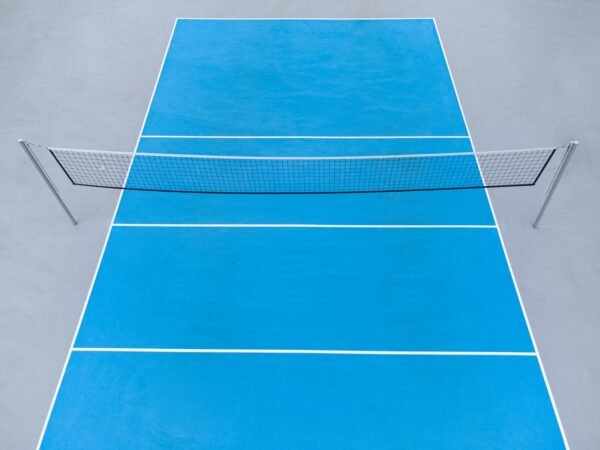
Blue Court. Aerial view from the drone.
How do you build a DIY pickleball court? The easiest way to start is with the ground. Choose a flat area and clear it of debris. The dimensions of the court are 20 feet wide by 44 feet long. With stakes and string, outline the court and make sure to level it out, so it is a safe and proper playing surface. Make sure to have a little more for players to run along the court for balls that are still playable but outside the lines.
From there, you can install a blacktop, concrete, or even plywood surface. It may make the most sense to have a professional surface installation team do the job. Their cost is generally fairly low though sometimes already included. Not only will they provide all of the necessary supplies, they will also make sure this project is done quickly, safely, and correctly. From there, simply create the netting system and start to play.
What are some fun ways to make the pickleball court my own? Consider creating a “stadium” feel with this court if you have some additional yard space to work with. Outside of the playing lines, paint on a logo or your family name. You could also put up some stadium lights, allowing you to play late into the evening as well.
Maintenance Tips for Your Backyard Pickleball Court
Preserving the lifespan of your pickleball court and its playability requires regularly scheduled maintenance. That’s because a clean, well-maintained court is not only more fun to play on, but it also helps to prevent repairs that might end up being pretty expensive.
Maintenance can be as simple as sweeping away leaves or surface-cleaning with a mild soap, like Simple Green, and water from a hose; leave the pressure-washer in the garage. By doing so, you eliminate built-up surface grime that contributes to reducing the amount of player traction and that consistent ball bounce.
On the other-hand, there are also more material court issues that ideally should be regularly looked for: small developing cracks, holes dug by small animals searching for food or longer-term burrows, court surface areas that have started to blister and break away should be repaired during the season using the appropriate patching or surfacing compound. Particularly if the issue resides where the majority of playing occurs. Doing so typically saves hundreds and hundreds of dollars later on.
Then there are those special season outdoor-court needs. One such issue like bringing in coverings for oncoming snowy weather or applying a sealer to the court surface finish before summer that extends the court durability annually.
A DIY backyard pickleball court can add fun to your life and value to your home. All you need is a relatively flat spot in your backyard, a ground-clearing tool, time, and paint or tape to map out the dimensions of the court to the backyard.
Then move on to the construction stage of your project: laying down a functioning hard court, which traditionally has been concrete, asphalt, or a similar material, and adding vital amenities and infrastructure: a net, paddles, and seating. Still, others might want to add landscaping or green space. After you’ve put your personal touches on your DIY project and the court is fully built, move on to the layout and line-marking specifics.
Other Articles
Best Pickleball Warm-Up Routine: Get Ready to Play in 5 Minutes
How to Hit Spin Shots in Pickleball: Topspin, Slice, and Sidespin Tips
Third Shot Drop Explained
Pickleball Strategy for Beginners
Pickleball Player Ratings Explained (DUPR/UTPR)
Pickleball Serve Rules & Techniques
Pickleball Scoring Made Easy
Pickleball Fitness & Injury Prevention Tips
Pickleball Terms and Definitions
